
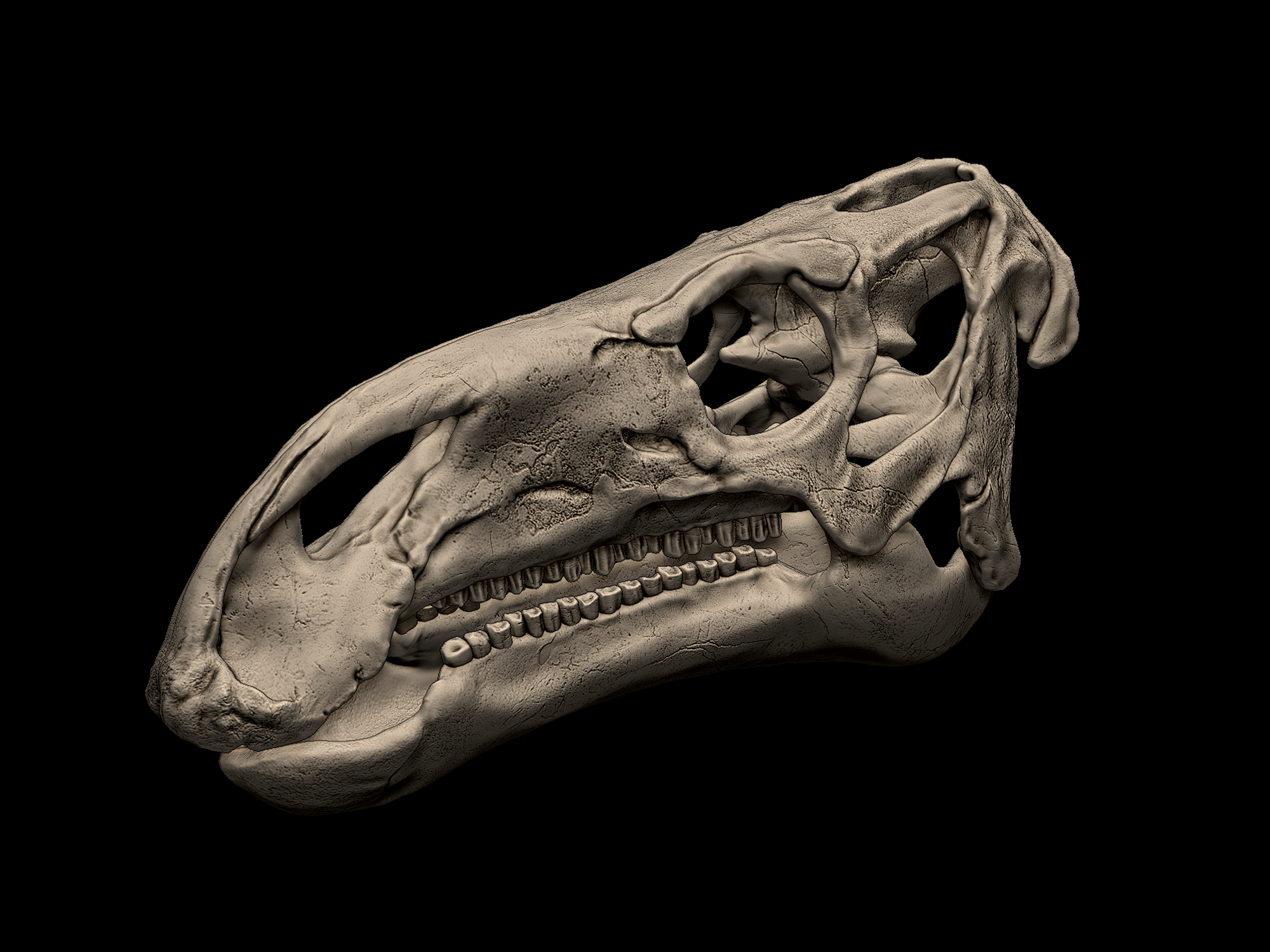
Iguanodon bernissartian
Part of the CRESTS & HERBIVORES Exhibit
Early Cretaceous Period, approx. 126-122 million years ago
1:3 Scale Skull Replica
SPECIMEN PROFILE
Iguanodon bernissartensis was a large ornithopod herbivore that inhabited the forested floodplains and river systems of Early Cretaceous Europe. It was among the first dinosaurs ever scientifically described from substantial skeletal remains, playing a major role in the early development of paleontology and dinosaur reconstruction.
Its anatomy combined strength, mobility, and advanced feeding adaptations. Powerful hindlimbs allowed efficient bipedal movement when necessary, while sturdy forelimbs supported quadrupedal browsing behavior. The most distinctive feature was the enlarged thumb spike, likely used for defense, display, or intraspecific interaction. Its jaws contained dense rows of grinding teeth capable of processing tough vegetation, marking an important evolutionary stage in large-bodied herbivorous dinosaur development.
COLLECTOR & CURATOR NOTE
A historically significant Early Cretaceous ornithopod distinguished by its iconic thumb spike and advanced feeding anatomy—representing a foundational chapter in both dinosaur evolution and paleontological discovery.
CONSTRUCTION & DISPLAY
Scale
1:3, approx. 11.8 in or 30 cm
Fossil Finishes
Aged Bone: A weathered bone-white aesthetic, evoking exposed skeletal remains and museum restorations.
Canyon: Warm earth tones and terracotta hues, inspired by fossil beds such as Picketwire and Mill Canyon.
Fossilized: Deep browns and near-black coloration, replicating the mineral-rich preservation seen in authentic fossil specimens.
Specimen Format
Unmounted study specimen: A standalone skull, ideal for shelves, cases, or custom display setups.
Desktop-mounted display specimen: Presented on a handmade desktop stand, crafted from wood with brass furnishings and a custom specimen placard — designed to elevate the specimen as a true exhibit piece.
Medium
Hand-painted resin
Cancellations:
Cancellations must be requested within 48 hours of order placement.
Orders that have already shipped cannot be cancelled. Once the item has been delivered, you may request a return if it meets our return eligibility requirements.
Returns & Exchanges:
To initiate a return, contact us with your order number within 30 days of receiving your order. Most items, including Made to Order products, may be returned if they meet our return eligibility requirements.
Personalized or custom items are not be eligible for return.
We do not offer direct exchanges. If you would like a different item, please return the original item (if eligible) and place a new order.
Damages:
If your order arrives damaged, contact us within 48 hours of delivery with your order number and photographs of:
The damaged item
The shipping box
The shipping label
The packing materials
We recommend retaining all original packaging until your order has been inspected and accepted.
For complete details, eligibility requirements, timelines, and exceptions, please read our FULL Shipping and Returns Policy.
This listing is a Made to Order item. Each replica is individually produced, textured, and hand-finished after your order is placed, rather than being pulled from existing inventory.
Current Production Time:
Estimated Lead Time: __ Weeks
This item is individually produced after purchase. Production typically requires 2–6 weeks, depending on current studio workload.
General Shipping Policy:
Every order is carefully inspected and securely packaged to help ensure it arrives safely and ready for display.
Assembly
Some replicas may arrive partially disassembled to ensure safe transit. Minimal assembly may be required, and clear instructions are included where applicable.
For complete shipping information, delivery estimates, additional details, and policies, please read our FULL Shipping and Returns Policy.